Thursday, 18 September 2014

Art & Craft at Kirsty's Handmade Fair

My relationship with 'craft' is, truthfully, not that great.  Basically, I'm better at buying it than I am at doing it.  It's one of those things - like cooking - that I totally mean to get the hang of, i.e. I fully intend that one day I'll make staggeringly beautiful quilts (in a How To Make An American Quilt kind of way) - and there's a bit of me that aspires to the handmade embroideries in the V&A -   and then it takes me an hour and a half to sew on three name tapes and I remember the issues that I'm facing:  impatience, lack of lasting enthusiasm, and, most crucially, total ineptitude.  (And my mother-in-law already makes staggeringly beautiful quilts, so I don't really need to.  As for the embroideries?  There's a tapestry I was given when I was 10 that I still haven't finished . . . )

But every so often I forget all those things, and cheerfully go off to spend an afternoon at the V&A learning how to make paper cut-out bunting with Kirsty Allsopp and Poppy Chancellor, because, you know, it sounded fun, there was the promise of cupcakes, and we all love Kirsty, don't we?

It transpires that making paper cut-out bunting is ridiculously time consuming, horribly fiddly, and actually not that much fun.  What was enjoyable was eating the goodies from the Hummingbird Bakery, and chatting to the other women there - about our children, yes, but also about Russian art, Russian emigres, the future of 'handmade' (I was sitting opposite the editor of Selvedge Magazine) and who are the contenders for best playwrite of our time (we never definitively agreed on an answer.)  And that bit, the cake and - more pertinently - the conversation, made spending two hours with a scalpel worthwhile.

And at least Kirsty was doing it too.

And this was tea . . . 

And that is Kirsty's point - that craft is about bringing people together, forming and preserving communities - it's a bit WI-y, but kind of brilliant and why she has launched The Handmade Fair, which opens today at Hampton Court and is on all weekend.  There are numerous skills workshops, from painting furniture with Annie Sloan (I've already done that course - at the Phoenix on the Golbourne Road - and it's brilliant, though I've yet to actually put any of it into practice at home - I initially visualised Omega workshop/ Charleston-like wardrobes, doors, floors and everything else - see 'lack of lasting enthusiasm') to food decorating, sewing (though not name tapes, I note), Etsy business school . . .  basically everything that any craft enthusiast could possibly dream of, and more.

The drawing room at Charleston

Fortunately, for people like me, there's also shopping . . . .

I love Molly Mahon's block printed fabrics, wallpapers (which you can see at Tent, also taking place right now) lampshades and stationery.  I have rather a lot of it already, but there's always room for more . . . 

I'm obsessed with everything about The Painted House.  I fully intend to actually buy some of their rollers, and redecorate our walls - or at least the cupboard doors - at home.  I feel that this is within my grasp.  Maybe . . . 

How hard is it to find attractive place mats?  Answer: very hard.  I know this because I've actually spent a long time looking.  I could make my own!  (If I were even remotely talented.)  Or I could buy these.  How pretty?

There is one very valuable lesson that I took away from the craft workshop, however, and that is that next time one of my sisters gets married, I'm totally inviting all my friends over for bunting-making and cake.  Many hands, it transpires, really do make light work . . .  (and nobody at the V&A tea resorted to stapling the triangles onto the ribbon.)

www.thehandmadefair.com


Sunday, 14 September 2014

Fine Photography: Where to Find It, How to Buy It

Between the various photography exhibitions that are currently running (Dennis Hopper at the RA, Horst P. Horst at the V&A, Edwin Smith at RIBA, to name but three) and spending a good couple of days thoroughly immersed in a review copy of Vogue The Gown (coming out next month, it's amazing, pre-order it now) I've spent more time than usual dwelling on that particular medium.

Edwin Smith:  Campo San Giorgio Maggiore, Venezia, Italy, 1961

Photography is one of the fast growing segments within the art market.  Collecting it in itself is not new - it was practically simultaneous with the invention of photography:  P&D Colnaghi were selling photographs as early as the 1850s, representing the work of Roger Fenton and Julia Margaret Cameron - about whom I once wrote a paper while at university.  (Pointless aside.)  But early photographs were usually collected to be kept in albums, not hung on a wall, which is certainly not the case now.  (There's a lengthy explanation, incidentally, which I'm mainly glossing over - but photography first started properly being viewed as a fine art form in the 70s, which was partly to do with artists like Cindy Sherman and Richard Prince etc., and partly to do with museums forming photography departments and appointing dedicated curators.) And whether it's early photography that one is interested in, or fashion photography or landscape photography or the work of young photographers, the market is responding to demand:  i.e. there is a lot of choice.  (The Paris Photo fair has become so successful that, as of last year, it takes place in LA, too.)

So I asked my brilliant friend Brandei Estes, who is Deputy Director Specialist Photographs at Sotheby's, (and who has previously worked at the Michael Hoppen Gallery, and at Brancolini Grimaldi, and at various other places besides - she knows everything) for her tips on collecting:

1.) Be informed.  Know the galleries that represent photographers; go to the shows, speak to the gallerists; go to the fairs, meet the dealers; go to the auction houses and look at the pre-sale exhibitions.

2.) Understand the difference between the primary market (a gallery exhibiting and selling new work by an artist) and  the secondary (anything sold by a dealer or at auction.)  Be aware that the estimate at auction is always going to be lower than the price of a piece sold on the primary market.  

3.) Understand the process.  A vintage print by, say, Cecil Beaton will be more expensive than a modern print which will be one of an edition offered to the market by Beaton's estate.  And, when it comes to editions, limited editions are better than open editions - and the smaller the print run the better.  Techniques have developed and changed over the course of time - pre-80s photography was mainly printed by hand, for instance - this can affect the price and the longterm value.

4.) Provenance is key, whether you're buying from an auction house or a friend.

5.) The condition is important.  Saying that, vintage prints will usually be a bit scratched and beaten up - I'd be very suspicious of a vintage print in perfect condition.

6.)  But ultimately, buy what you love, be aware of your budget, and be careful with your expectations (nobody can guarantee that what you've bought is going to quadruple in value within five years.)

My own, rather limited, collection of photography is very much founded on that sixth principle, insofar as I've only ever acquired what I love - although I've been fortunate, and have been given some of the pieces that I treasure, such as this:

Marie Helvin by Barry Lategan for Vogue 1971.  

As always though, there is so much more that I would love to see hanging on my walls, and I often find myself pouring over the catalogues of the Sotheby's photography sales - there's a particularly tempting Man Ray sale taking place in Paris on 15th November:

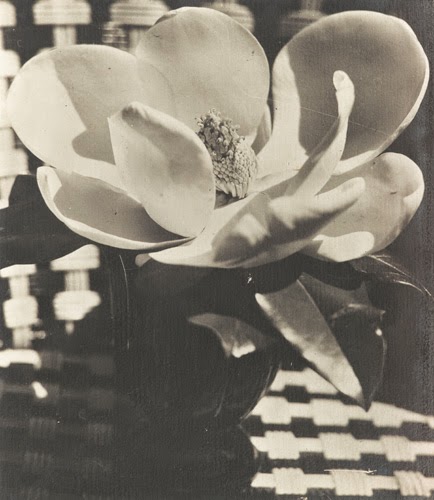
Man Ray, Magnolia Flower, 1926, silver print, estimate: 30,000 - 50,000 EUR

Man Ray, Lee Miller with sponge necklace, 1930-31, silver print, estimate: 40,000 - 60,000 EUR

Tragically, I'm not sure that my bank balance will be able to support my bidding on either of those (unless of course I win the lottery between now and mid-November.  My odds of which would be greatly improved by buying a ticket.)  Nor can I afford a Lucien Herve, the architectural photographer  - he was Le Corbusier's official photographer - of whose work there is currently an exhibition at the Michael Hoppen Gallery and some of whose works will also be found at  the Barbican's Constructing Worlds, Photography and Architecture in the Modern Age, which opens on the 25th September.  I am obsessed.  

Lucien Herve

However, for those who are similarly bank balanced to me, I bring you glad tidings of great joy . . . . . . Lumitrix:

Matilda Temperley (yes, her sister), Dancer 1 (I have this on my stairs.  I love it.)

Dave Watts, Persepolis  (Horst's photographs of the same Iranian temple, which were published in US Vogue in 1949, can currently be seen at the V&A) 

Astrid Harrisson, Circling at Dawn. I fantasise about owning this.  It shows the legendary Marwari horse being exercised in the Rajhastani desert by Marwar horsemen. 

Lumitrix sells in two ways.  They started with the 'Lumiprint', into which category the Matilda Temperley falls:  each is a commercially printed lithographic print on 250gsm silk paper, the edition is 500 (high, but it is still an edition - see Brandei's point number three.)  The Watts and the Harrisson fall into the Fine Art category - professionally printed on fine archival paper each work is in editions ranging from 25-100, depending on the size.  The costs vary, obviously.  A Lumiprint is £50, Fine Art ranges from £90 (for the smallest size at the print run of 100) to £850.  

But what price beauty? FMJ.


Dennis Hopper is that Royal Academy until the 19th October

Horst is at the V&A until the 4th January

Edwin Smith at the Royal Institute of British Architects until 6th  December

www.parisphoto.com

For all upcoming photography sales at Sotheby's, see here (seriously, don't forget the Man Ray on November 15th in Paris though . . . )

Lucien Herve is at the Michael Hoppen Gallery, 3 Jubilee Place, until the 24th October

Constructing Worlds, Photography and Architecture in the Modern Age is at the Barbican Centre from 25th September to 11th January

www.lumitrix.com - oh, and incidentally, Lumitrix are currently running a competition which closes on Tuesday night - you can win a print (amazing, no?!) - all you have to do is photograph the loneliest wall in your house - the details are here.


Tuesday, 9 September 2014

Cowgirl Dreaming


The decoration on the Chief’s Tepee exterior is based on Indian ledger drawings.

A while ago, AD Magazine did a story on Ralph Lauren's Colorado Ranch, which I have basically been obsessed with ever since:

The living room of the ranch’s main residence, constructed using local pine logs, is appointed with late-19th-and early-20th-century Indian rugs. An antique pine table from New Mexico and a turn-of-the-century pine farm bench stand on a circa-1890 Navajo rug. A beaded parade saddle by Edward Bohlin straddles the staircase railing, while an original Frederic Remington bronze is displayed by the window. A Plains Indian leather pillow on the sofa is embroidered with an American flag.

Ralph Lauren Home linens mix with antique and vintage bedding on the cabin’s 1870s cannonball bed; a circa-1900 hooked rug and two ’20s Navajo rugs are on the floor.

Overlooking the cabin’s living room is a chandelier made with naturally shed elk antlers; beside the hearth, a woven-twig rocking chair is draped with a vintage Capps Indian-trade blanket, and an antique New Mexico pine table stands atop an early-20th-century Navajo rug.

Antique Navajo rugs decorate the walls of the ranch’s screening room, which features club chairs, wing chairs, ottomans, and velvet curtains, all by Ralph Lauren Home, as well as antique Pendleton and Beacon blankets.

A group of Navajo blankets, circa 1880s–1910, hangs in the entrance to the ranch’s gym; the rug is a circa-1910 Navajo saddle blanket.

The saloon’s porch is furnished with 19th-century Mexican sabino-wood pieces, including a table made from a salvaged door and ox yokes; the tableware and linens are by Ralph Lauren Home.

The San Juan Mountains provide a scenic backdrop for the ranch’s five tepees, built and hand-painted by local artisans; the free-form pool resembles a natural pond.

And looking at these, aren't you?  Tragically, I'm not currently in a position to purchase a similar style ranch in Colorado, but as ever the chief allure for me is the idea of getting the look.  I am convinced that all I need to do is chuck a choice selection of Beacon and Pendleton blankets over my sofa, cover our Algerian rug with some Navajo saddle blankets, and, when it comes to reupholstering anything, focus more on the Trading Post collection from Ralph Lauren Home and less on Colefax & Fowler . . . and hey presto, my Notting Hill flat will be indiscernible from anything you can see above.  (Regarding that Trading Post collection, Vogue recently hosted a party at the South Kensington Ralph Lauren store - part of the Ricky bag world tour. I accidentally spent all night in the basement, pulling out fabric books . . . )

Blackbird Wool Blanket by Ralph Lauren Home

Sacred Mountain Blanket by Ralph Lauren Home

Santa Clara Blanket by Ralph Lauren Home

Are these not total heaven?  Their other joy is that these are pretty easy (though obviously not cheap) to acquire.  It's a matter of picking up a credit card.  Harder are the other things I mentioned - in particular the Navajo saddle rugs and the Beacon blankets - those last are no longer made (Beacon came to an end in 2002) and one wants to get them from a particular period, basically pre-1950 which is when the legendary company - at one point the largest blanket manufacturer in the world - started adding rayon to the cotton.  (It got worse.  By the time they closed, they were making blankets out of acrylic.)  And ideally you want to find one dating from pre-1932, which is when the Navajo Indian tribe failed a complaint - Beacon had been using images of American Indians at looms weaving blankets in their advertising - and the company was ordered to stop using Indian images and to make clear that the blankets were not woven by native Americans.  (Okay, so the pre-1932 ones might not be the last word in political correctness.)

Vintage Beacon blankets

However Pendleton Blankets are still very much in production, and currently at the top of my wish list.  There's a whole collection entitled 'Native American Inspired', and I kind of want all of them, but I also kind of want all their rainbow striped ones, and even all their National Park ones, even though I've never been to a single American National Park (though this will obviously change when Andrew and I get around to doing our road trip across America, with the children. Don't hold your breath.)

Pendleton Blanket

So there we go. Easy peasy ranch style, courtesy of Ralph Lauren and Pendleton.  And, once you've done all this, you can spend your days drifting around in a variety of looks for the modern cowgirl from the Ralph Lauren Spring/ Summer 2011 collection.  (I know, not so helpful of me to tell you now.)

I'm particularly enamoured of the middle look.


And, you can add to it with pieces from Ralph Lauren's very own online vintage store, where he sells the most exquisite items - such as a shawl coat made out of a Beacon blanket.


Oh, and as a total aside but totally relevant (unlike the rest of this post) Ralph Lauren has literally just opened a Polo flagship store on 5th Avenue.  And this little gem is somewhere to be found within it:


Finally, I'd like to share my new favourite expression:  "All hat and no cattle." Which will be me, if I go in for any of the above . . .  (except, perhaps the odd Pendleton blanket or two.)


All photographs of Ralph Lauren's Colorado Ranch are by Bjorn Wallander

www.ralphlaurenhome.com
www.pendleton-usa.com
www.rlvintage.com


Sunday, 7 September 2014

Seasonal Denial: Tom Scheerer's Bahamian Idylls

My denial is not absolute - I actually love this time of year - but while every other child in the world seems to have started the new school year (which I know because of Instagram) Sholto's school still hasn't finished being built, so my usual 'ooh it's September' excitement and drive hasn't had a chance.  Days are still consumed with building his lego with one hand, preventing Esmeralda from destroying it with the other, playing Sylvanian Families with her at the same time as expressing an interest in his drawings of Teenage Mutant Ninja Turtles ("Gosh darling - is that Leonardo or Michelangelo?") while all the time wondering how I can disguise broccoli as chicken gujons.  So forgive me when I tell you that my children don't currently figure particularly largely in my dreams of escapism - speaking of which, it's a toss up between being a cow girl in Colorado (based at Ralph Lauren's ranch, obviously) and wanting to move to the Bahamas.  And the main inspiration behind the longing for an island life is this:

The Lyford Cay Club, decorated by Tom Scheerer.  Those palm trees are hand-painted.

I mean, those walls!  The New York Times described the room as setting "a new standard for the vitality and relevance of American aristocratic decorating," while adding that  "Slim Aarons didn't live long enough to shoot this one, but he would have deemed it worthy."  All I know is I want to live in it because, in spite of the grandeur and scale of those trees, it looks supremely comfortable, does it not? "Elegance," Scheerer has been quoted as saying "is really about economy."  

And then I found another house in the Bahamas that Scheerer has decorated - I could so live here.  And India Hicks makes Bahamian life look so especially idyllic . . . .  Which is actually totally relevant because while Scheerer studied architecture at Cooper Union, when it comes to interior design he credits David Hicks, India's father, as a mentor, naming him a master of "fresh, civilised, beautiful, unpretentious spaces."  Which basically describes Scheerer's own style:


To finish, here's another view of those palm trees. 


(Were I a more patient mother I would doubtlessly get the children to paint approximations on the walls at home - in a Matisse cut-out kind of way.  But the Chelsea Textiles cushions still haven't entirely recovered from my "Let's paint Carnival!" idea, enthusiasm born of two days worth of steel bands and sound systems directly outside our house . . .  The paints have been definitively hidden.) FMJ.


All photographs throughout are by Pieter Estersohn
www.tomscheerer.com


Thursday, 4 September 2014

Frocks, Fantasy, Faraway Lands and Fabulous Interiors: Horst P. Horst at the V&A

Having spent the entirety of my twenties at Conde Nast, I am happily on familiar terms with the Vogue library, which is situated in the basement of Vogue House and contains all the back issues of every Vogue, ever.  Flicking through them is like discovering that fabled other country of the past - here are glimpses into an era when women dressed for dinner, here are adventures undertaken by Norman Parkinson, here is Her Majesty the Queen as a young girl photographed by Cecil Beaton, and here are couture gowns of the thirties and forties, eternalised by Horst.  (And then your eyes go funny, in the desperate search for the Irving Penn image of the woman having milk splashed in her face/ the Willy Rizzo image of a woman in a hat and net over her face/ any other iconic image by any other iconic photographer that you know is somewhere, in either British/ French/ American/ Italian Vogue, sometime in the 60s, but if it was syndicated, where did it appear first?  AND WHEN WILL ALL THE ARCHIVES ALL BE DIGITALISED?!)


Helen Bennett, 1939  © Condé Nast/Horst Estate

But all that is an aside; this is about Horst, who is the subject of a new exhibition at the Victoria & Albert Museum - who call it "the definitive retrospective exhibition of the work of master photographer Horst P. Horst (1906-1999) - one of the leading photographers of the 20th Century" - which opens this weekend, and I would urge anybody to go, whether or not they have an interest in frocks.  For while the exhibition explores his collaborations and friendships with such luminaries as Coco Chanel and Elsa Schiaparelli - and Marlene Dietrich and Noel Coward and Salvador Dali - it also shows Horst's other work.  His nude studies (there's a particularly exquisite Odalisque), his patterns created from natural forms (these didn't actually do much for me, though there were a few which I thought could become rather exquisite Luke Irwin rugs) and his travel photography from the Middle East, which is amazing, and all the more fascinating because, these days, even the most intrepid traveller can't readily reach places that he visited.  In this instance, the past really is another country.


View of ruins at the palace of Persepolis, Persia, 1949. © Condé Nast/Horst Estate

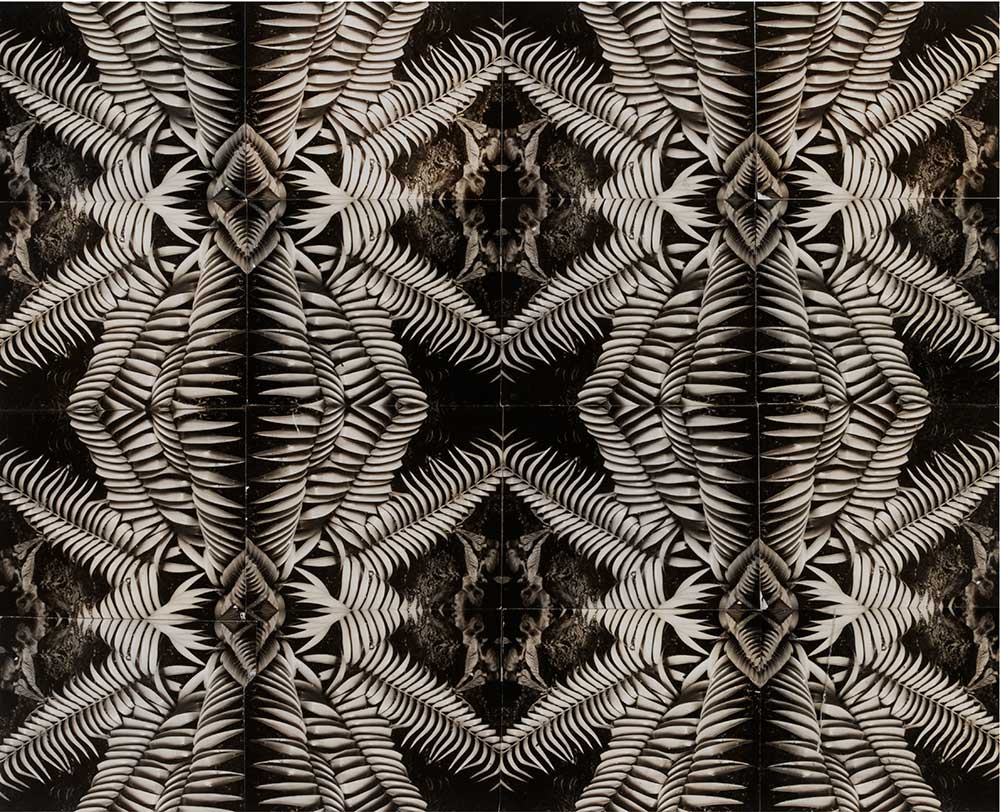
Patterns from Nature Photographic Collage, about 1945. © Condé Nast/Horst Estate

Not Horst.  One of Luke Irwin's rugs from his Tarantella collection.  I'm still dreaming of a Luke Irwin rug. 

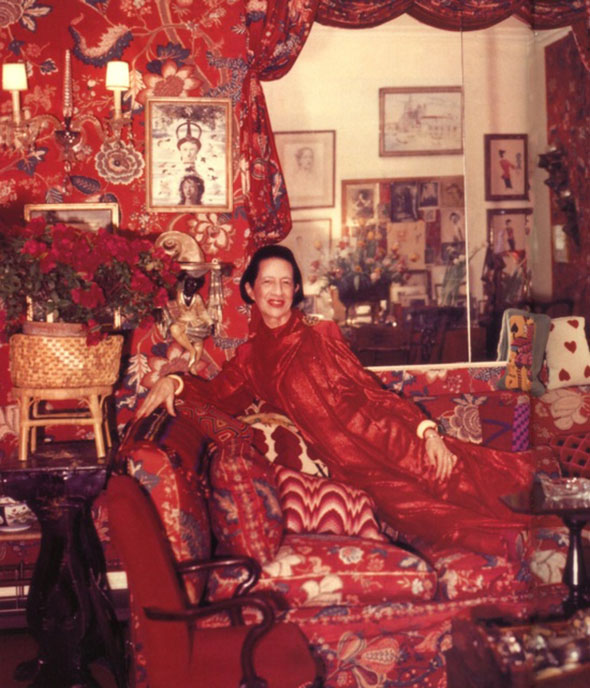
And Horst photographed interiors, too.  He was published in House & Garden as well as Vogue, and it was he that is responsible for that incredibly famous image of Diana Vreeland, then Editor of American Vogue, in her drawing room which she arranged to be red, 'like a garden in hell'.  The picture isn't actually in the exhibition, but here it is:

Diana Vreeland, at home.  There's a wonderful letter from Vreeland to Horst in the exhibition:  "Dear Horst," she writes.  "I cannot tell you how perfectly beautiful I think your pictures of Persia are . . . "

(Incidentally, I am currently obsessed with red.  Obsessed.  I'm going to have a chair upholstered in this amazing fabric - Snow Tree by Colefax & Fowler - it was inspired by a paper from Drottningholm Court Theatre in Sweden, a piece of which was given to Nancy Lancaster, who was then owner of Colefax & Fowler, by the King of Sweden.  Is it not heaven?)

Snow Tree in red, by Colefax & Fowler

And Horst photographed Nancy Lancaster's house, too.  Obviously.  For after all she was one of the greatest influences on interior decoration and garden design in Great Britain and America in the second half of the 20th Century.  Those images, too, aren't in the exhibition, but many others are, including one of the apartment that Horst lived in in Paris, which was published in British Vogue in 1931, and which - unlike my house - is a masterclass in serenity.  (He also photographed Karl Lagerfeld's Art Deco apartment, and Yves Saint Laurent at home, but I bumped into my friend Deep, who is Fashion Director of Tatler, before I got to the final room . . .  and we were discussing jean shopping for the New York shows which she's about to fly out for, and the changing fonts on the the covers of Vogues of yesteryear - there's a great collection of covers with some seriously great fonts . . . . and then I remembered I had a lunch.  I have to go back.)  

So go.  It chronicles an era (rather like this post, colour appears half way through) and has moments of beauty that touch on the sublime.  FMJ.


Horst is at the V&A until the 4th January (and, while you're there, you could always pop into the Disobedient Objects, too . . . )
www.lukeirwin.com
www.colefax.com


Friday, 20 June 2014

A Garden is a Lovesome Thing . . .

I've spent rather a lot of time thinking about gardens recently.  Firstly, there was the Chelsea Flower Show, which may seem forever ago now but one particular garden - namely The Topiarist Garden - seems to have become imprinted on the cornea of my mind's eye in such a manner that I literally can't stop seeing it, and therefore dreaming about it.

I just want a bit of room to practice some topiary and grow some box hedges of my own, and that is not going to happen on my balcony.

Fortunately, some (very) bright spark has come up with the idea of a new sort of 'garden' show:  Grow London, a garden show for people who don't have gardens.  That spark is Will Ramsay, who also founded the Affordable Art Fair (bringing original art to the walls of the masses); he's now aiming to 'democratise' gardening for people who only have access to window boxes, i.e. me.   It's on all weekend, in Hampstead (you can get the overground to Hampstead Heath) and I thoroughly recommend it.  (And, should you wish to make a whole day of it, the utterly amazing 2 Willow Road, Erno Goldfinger's former modernist home, is just around the corner.)  The only problem is that your longing for a garden won't necessarily decrease having been . . .

But how could it, having seen foxgloves like these?  I'd forgotten just how perfectly exquisite foxgloves are.

And look!  Olive trees and lavender, the most perfect combination ever.  Cleverly, everything here is in pots, so you really can conjure up a Mediterranean-style garden on a tiny concrete balcony (though perhaps not if your balcony is quite as tiny as mine.)

There were also a whole host of garden-type accessories:

I desperately want an Edwardian sun shelter from Deckchair Stripes.  Desperately.  Again, however, it's not going to fit on my balcony . . . 

I can, however, buy deckchair canvas by the metre.  Not that I'm immediately sure what I'll do with it, but oh my goodness the colours!

And check out their bobble trim.  Did you ever see anything so heavenly?  Seriously, when I do have a garden, I'm going to know exactly how to accessorise it.

The other stand I fell for, totally hopelessly head over heels, was Rush Matters, which is a company owned by Felicity Irons, and I hope (crossed fingers) that we're going to be able to stock her products on English Abode.

Here is Felicity harvesting the rush.

Then she turns the rush into the most insanely comfortable cushions, as per this image, and rush rugs and mats etc.  Did you know that you need to occasionally water a rush rug?  Because I didn't.  One of the things that she makes is rush bath mats; a bathroom, she explained, being absolutely the ideal place for rush to live because it gets watered on a regular basis.

And then she makes these utterly amazing rush shoes.  When I have a garden, these are all I shall wear in them.

For now though, the garden is still far off - however long I spend reading gardening books and reviewing them on English Abode.  But speaking of English Abode, we have got some rather amazing gardening pieces for people-who-don't-have-gardens, ourselves:

These Foodie Garden growing kits, for instance.  Ready prepared trays for tomatoes, peppers, basil and more are all available (they take about a week to start germinating) and I've just ordered the lot.  I'm very keen that Sholto and Esmeralda should have a chance to grow there own something this summer, and I'm hoping that the experience is going to go some way to stopping me buying an old Citroen van and setting off around England selling hydrangea and lavender from the back of it.

Because that's basically all I want to do at this precise moment in time.  And looking at this, don't you?!


Grow London - www.growlondon.com - continues through Saturday and Sunday from 10am to 6pm at the Lower Fairground Site, East Heath Road, Hampstead.  Go.

www.deckchairstripes.com

For everything else, there's www.englishabode.com